Infrastructure Programme Management | Delay-Aware Planning | Project Controls
Integrating Planning and Delay Awareness in Complex Construction Programmes
1. Introduction
In complex construction programmes, planning and delay assessment are often treated as separate functions. Planning is typically associated with schedule development and progress monitoring, while delay awareness is addressed only when disruption becomes evident.
This separation limits the ability of project teams to respond effectively to emerging risks.
Based on direct involvement in programme management and schedule analysis across complex, multi-stakeholder construction environments, where early-stage disruption often remains undetected within conventional monitoring systems, it becomes evident that the lack of integration between planning and delay awareness leads to delayed decision-making and reduced programme control.
A more effective approach requires embedding delay awareness directly within planning processes, allowing programme data to be interpreted not only as status information but as an early indicator of potential disruption.
2. Limitations of Functionally Separated Planning Systems
Conventional planning systems are structured around programme development, progress monitoring, and schedule updating. These functions are often executed independently of delay evaluation processes.
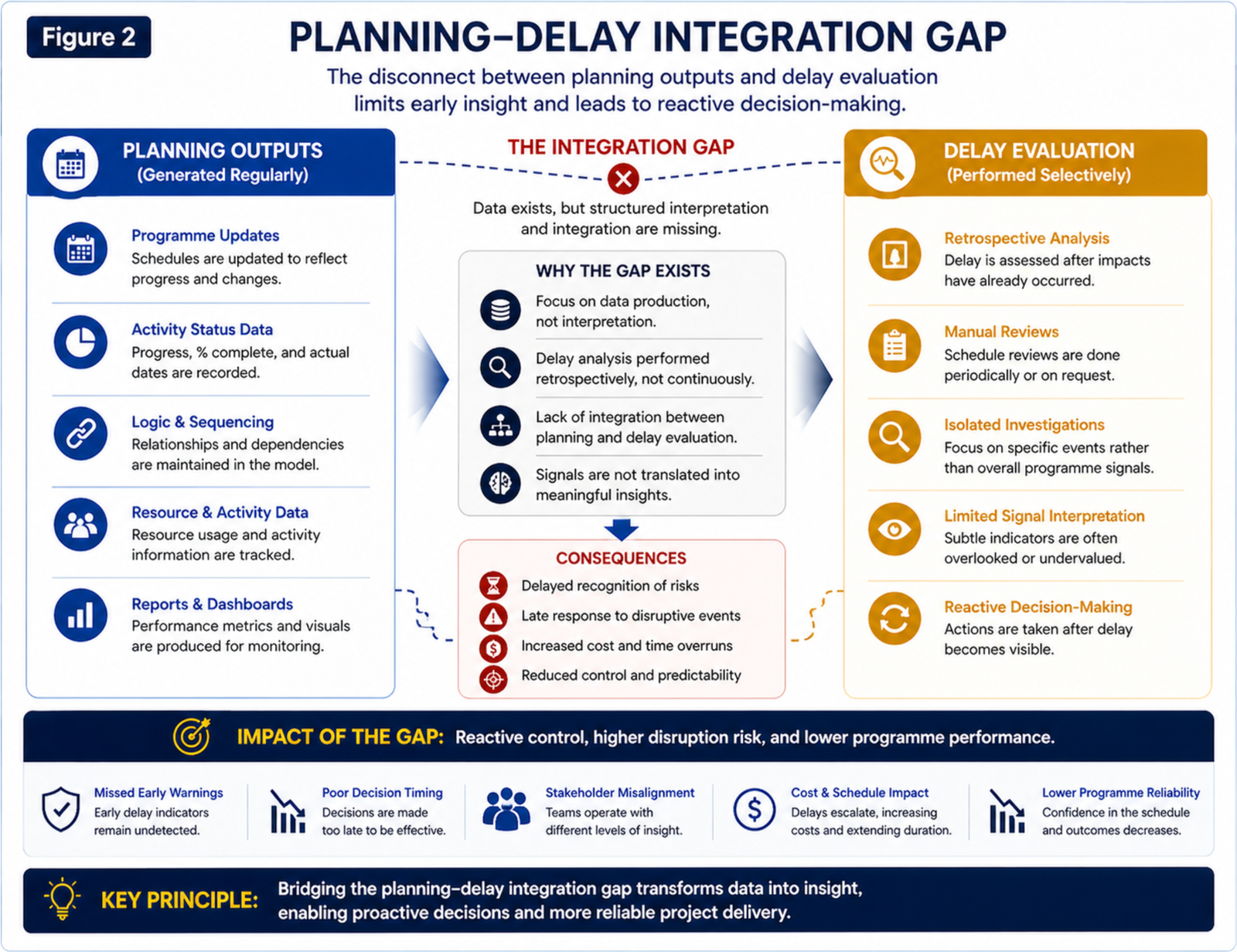
As a result, planning teams focus on maintaining programme accuracy, delay analysis is performed retrospectively, and risk signals are not systematically interpreted.
This creates a condition where data is available, programme updates are frequent, but early indicators of delay are not recognized.
This limitation is not isolated to individual projects but is commonly observed across large-scale infrastructure programmes where coordination complexity is high.
The absence of integration leads to a reactive approach, where delay is addressed only after measurable impact has occurred.
3. Delay Awareness as an Embedded Planning Function
Delay should not be treated as a downstream issue. Instead, it must be understood as a condition that develops progressively within the programme structure.
Effective planning requires the ability to recognize early indicators of disruption, interpret changes in programme logic, and assess potential impact before it materializes.
This requires shifting delay awareness from a separate analytical activity to an embedded function within routine planning processes.
In this context, planning becomes not only a tool for scheduling but also a system for continuous programme interpretation.
4. Integrated Planning-Delay Framework (IPDF)
To address this gap, an integrated approach is required.
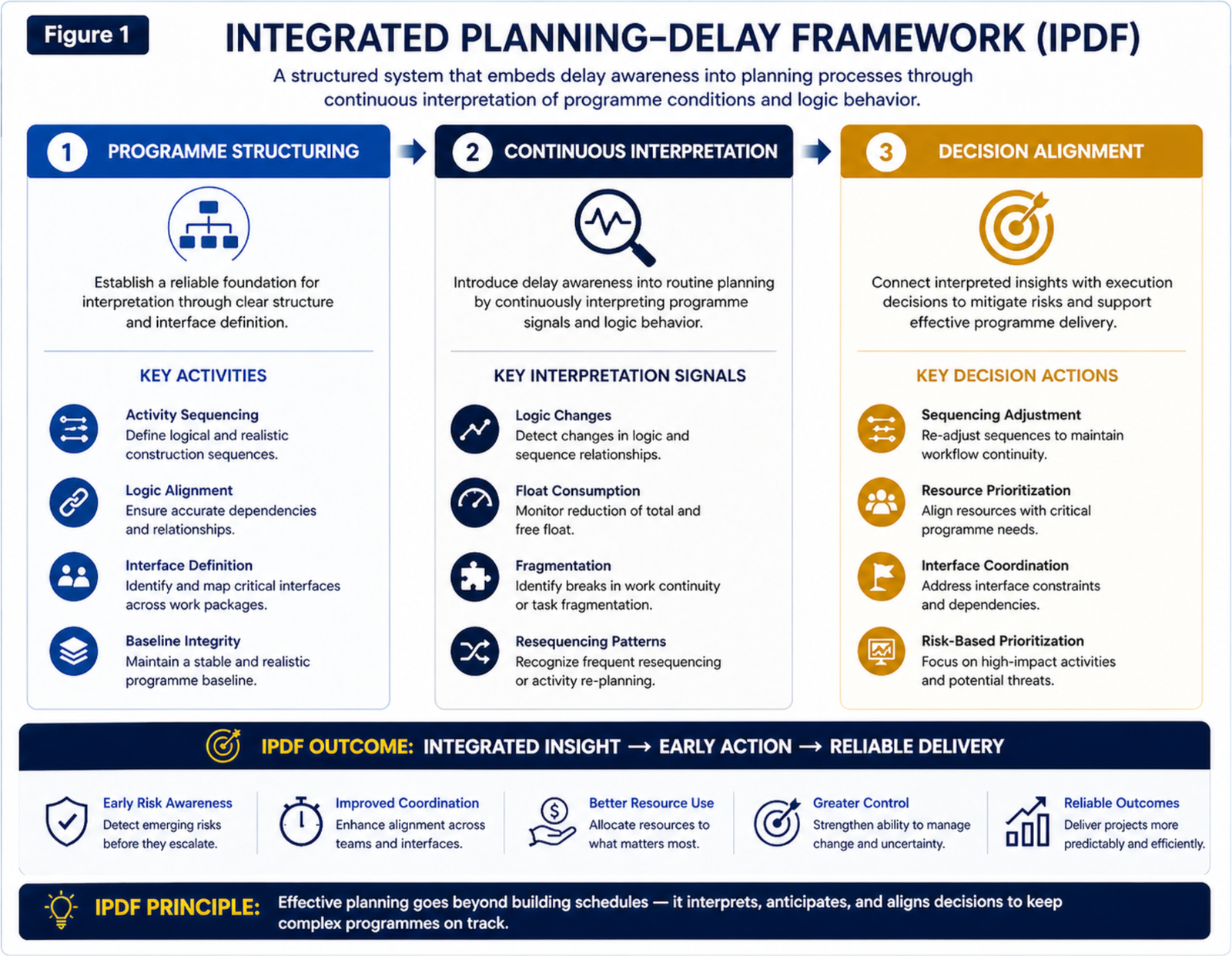
The Integrated Planning-Delay Framework (IPDF) is defined as:
A structured system that embeds delay awareness into planning processes through continuous interpretation of programme conditions and logic behavior.
The IPDF is not intended as a project-specific approach, but as a repeatable framework applicable across infrastructure programmes where schedule complexity and interface dependency are dominant characteristics.
The framework operates through three interconnected components:
Component 1: Programme Structuring
Programme structuring establishes a reliable foundation for interpretation through clear activity sequencing, logical dependency alignment, and interface definition across work packages.
A well-structured programme enables accurate identification of deviations and emerging risks.
Component 2: Continuous Interpretation
Continuous interpretation introduces delay awareness into routine planning through monitoring of logic changes and sequence disruptions, identification of float consumption patterns, and recognition of activity fragmentation and resequencing.
This component ensures that programme updates are not treated as static data, but as evolving indicators of project conditions.
Component 3: Decision Alignment
Decision alignment connects programme interpretation with execution-level actions such as sequencing adjustments, resource prioritization, and interface coordination.
This ensures that identified risks are translated into actionable responses within the project environment.
The framework is designed to support consistent interpretation of programme conditions, enabling planning functions to operate as structured decision-support systems rather than isolated reporting tools.
5. Programme Signals as Integrated Indicators
When planning and delay awareness are integrated, programme signals become more meaningful.
Key indicators include shifts in activity sequencing, acceleration or delay in predecessor activities, reduction in available float, and increasing fragmentation of work sequences.
Individually, these signals may appear minor. However, when interpreted within the programme structure, they reveal emerging coordination issues, potential disruption in workflow continuity, and increased likelihood of downstream impact.
When assessed collectively, these signals provide a structured basis for anticipating disruption rather than reacting to its outcomes.
The value lies not in the signals themselves, but in their structured interpretation within an integrated system.
6. Bridging the Gap Between Planning and Delay Evaluation
A common limitation in project environments is the disconnect between planning outputs, such as programme updates, and delay evaluation, such as analytical assessment.
This creates an interpretation gap where planning data is produced regularly, delay analysis is performed selectively, and the connection between the two is weak.
This gap is a recurring condition in complex project environments, where data availability exceeds the capacity for structured interpretation.
The Integrated Planning-Delay Framework addresses this by embedding analytical thinking within planning, ensuring continuous evaluation of programme conditions, and reducing reliance on retrospective delay analysis.
7. Application to U.S. Infrastructure Environments
The need for integrated planning and delay awareness is particularly relevant in U.S. infrastructure projects, which often involve multiple contractors and subcontractors, complex regulatory requirements, and high levels of public accountability.
In such environments, delays are rarely caused by single events. They emerge from interface misalignment, sequencing conflicts, and delayed decision-making.
In the United States, large-scale infrastructure programmes operate within highly regulated, multi-contractor environments where delays carry significant economic and public impact. The ability to integrate planning with structured delay awareness contributes directly to improving delivery efficiency, reducing disruption, and enhancing coordination across project stakeholders.
The framework presented is applicable across infrastructure and multi-interface projects, supporting more reliable programme control in environments where complexity and accountability are critical factors.
8. From Monitoring to Integrated Programme Intelligence
Traditional planning focuses on monitoring progress updates, schedule variance, and activity completion.
An integrated approach extends this function toward interpreting programme behavior, anticipating potential disruption, and supporting proactive decision-making.
This shift enables planning functions to contribute not only to schedule maintenance, but to forward-looking programme control.
Conclusion
The separation between planning and delay awareness limits the effectiveness of programme control in complex construction environments.
The Integrated Planning-Delay Framework (IPDF) provides a structured and repeatable approach to embedding delay awareness within planning processes. By enabling continuous interpretation of programme conditions and aligning analysis with decision-making, it supports improved coordination, earlier risk identification, and more effective programme control.
Such structured approaches to programme analysis are increasingly relevant in large-scale infrastructure environments, where complexity, interface dependency, and delivery pressures require more advanced planning methodologies. The development and application of systems such as IPDF contribute to strengthening project delivery practices in these contexts.